
Charlotte Guest was the winner of this year’s prize for Best Unpublished Manuscript in the Victorian Premier’s Literary Awards for her manuscript, The Kookaburra. Since then, she has signed with Allen & Unwin. The Kookaburra, the novel, will be published in August 2027
Charlotte is originally from Perth and now lives in Geelong where she manages the bookshop The Book Bird. I interviewed her for this profile for the Victorian Writers Centre, on whose website it was published in September
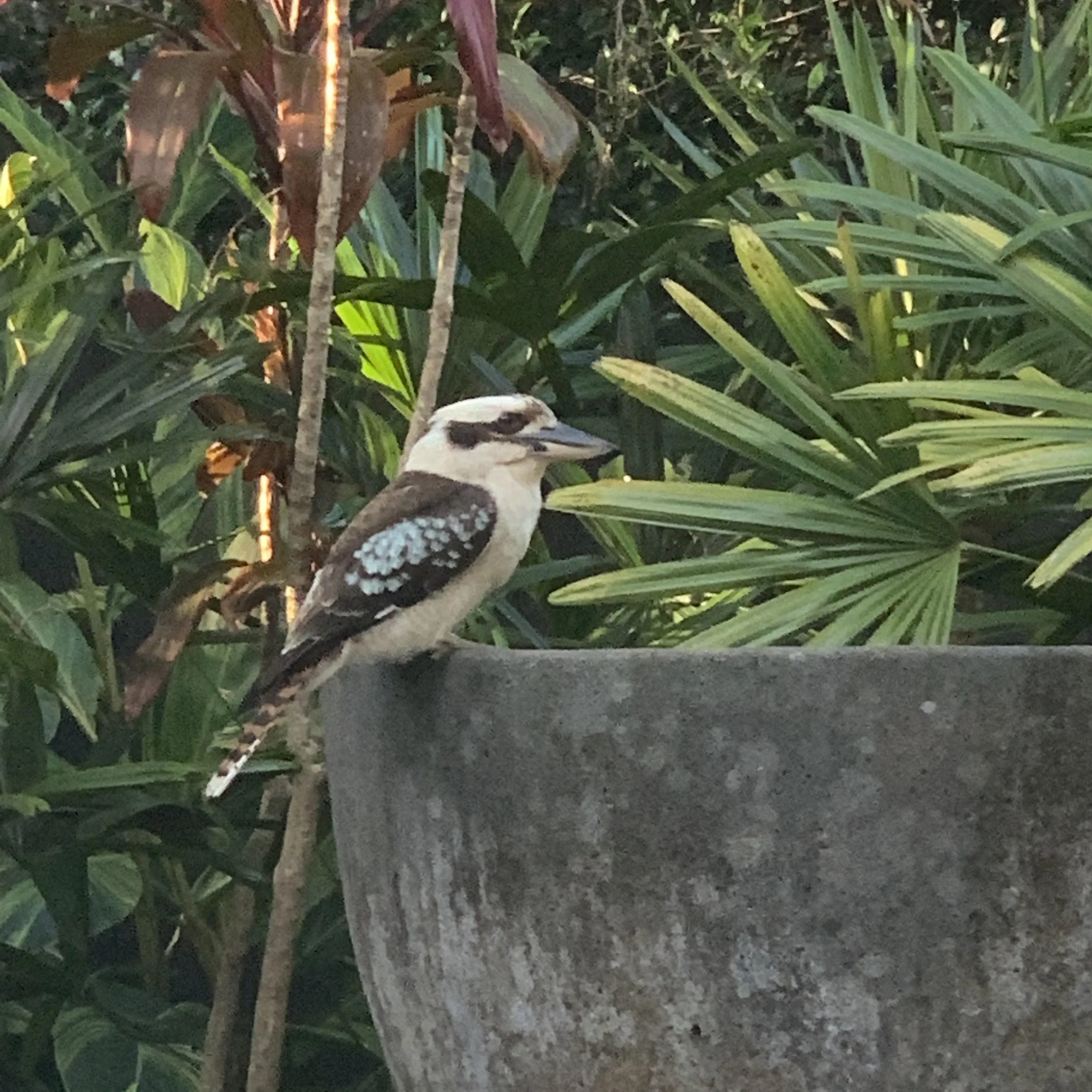
A visitor to my courtyard in Bryon Bay (not endangered)
A Perth childhood
WV
The beginning is a very good place to start. Did your interest in writing begin in childhood?
CG
Some writers say they had their instincts almost before they could walk. That wasn’t the case for me. I came to it a bit later
I grew up near a bush block outside Perth in the hills and, as an only child, I was outside all the time. I wasn’t interested in reading, I did a lot of sport, I was athletic. I didn’t come to reading and writing until late high school, then at university. I became a reader first, and there are certain books I read as a teenager that got me interested in this thing, novel writing. But it wasn’t until university that I started playing around with poetry and short stories
WV
And then you discovered that you had an aptitude for it. Is that how it went?
CG
I kind of found ‘story’ as a child (even if I didn’t find writing until later) because I was always read to before bed. It obviously got into my subconscious
My dad had been a lifelong gardener. He had three-quarters of an acre, and we had this big, beautiful, old tree. He read me The Faraway Tree books, as I think lots of kids still get The Faraway Tree books read to them. I loved it so much that he built things in the tree that were meant to be the Faraway Tree: platforms and little bridges. I had characters in the tree that were Saucepan Man and Moonface, and at the top was Topsy-Turvy Land. He brought the story to life in a way that must have made some sort of connection. It was a big part of my literacy as a kid, playing in the tree, feeling like I was in a book
Then I had some English teachers at high school who were inspiring, if a bit curmudgeonly. I thought they were grumpy but amusing. I had shocking handwriting for a while. I was writing in all caps, I don’t know why. I kept a diary since I was about 10, but they’re all in capital letters. It’s confronting when you read them, like I’m constantly shouting. One of the teachers made me practise my longhand over and over again, and this gave me the idea of sitting down and just writing
So, little seeds, little kernels were planted that connected me with writing. But it didn’t all coalesce until much later
University days
WV
So, university. What was your degree?
CG
My Bachelors was in the Arts, majoring in History, then I did Honours in Literature at the University of Western Australia. Then I worked for a bit at UWA Publishing. And after that I moved to Geelong in 2018 to do a PhD in Creative Writing at Deakin
WV
What kind of creative writing did you do for your PhD?
CG
I enrolled to do poetry, and my advisor was David McCooey, the poet. But I found I couldn’t make the project I had proposed work as poetry, so I redid it as a novel.
It ended up being a very Covid PhD in the end. The year of 2019 was on campus. Then, of course, we locked down in 2020, so the bulk of it was quite isolating, in a new place where I didn’t know anyone. My now husband is from America, and he moved to Victoria from San Francisco in January 2019. We were lucky he didn’t leave it much longer because he wouldn’t have been able to get into the country.
It was a tricky time, but I got through the research component and the novel. My thesis satisfied what it needed to be for a PhD and there are certain things I learned from it regarding craft and research. But I do think there’s a conflict between the strictures of a PhD—in terms of forming new knowledge and pushing boundaries, the aspects that make it an intellectual and research exercise and what it needs to do for a university context—and then, there’s how novels are written, that ineffable, often subconscious, knowledge you’re drawing on. I felt they were at loggerheads most of the time
But the main thing that I took from it all was the routine, the staying power, the endurance and having that close working mentor/mentee relationship with my advisor
WV
It’s well known that, like Ann Patchett, you work in a bookshop. Did you get the job at the Book Bird after you left Deakin, or were you working there all through your PhD?
CG
I was working there at the same time. I don’t remember how many days it was back then, maybe three, and I studied the rest of the week
WV
And when you left, did you know what you wanted to do next?
CG
I thought I wanted to go into academia because I had that background. I’d worked at UWA Publishing, and I’d done research projects in other capacities. I thought about doing sessional tutoring to go down the academic pathway, but sessional tutoring jobs were only offered contract-to-contract rather than as permanent positions or with a 10-year pathway. A lot of sessionals were really disillusioned. You look at the hourly rate, and you think ‘that’s good for teaching the class,’ but you’re not counting the preparation. And you’re out of work during the long summer holidays
So, I stayed at the bookstore, and I’m still there eight years later as the manager. But when I graduated in February 2023, I was at a complete loose end. My husband and I got married in the March of that year, and then, for various reasons, we didn’t go on a honeymoon until September. We went to Tasmania for a road trip holiday
The kookaburra
CG
We drove around Tasmania for two weeks. Once, we were just outside Scottsdale driving on those old windy country roads, and we came across an injured kookaburra on the road. It looked odd, surreal. It was clearly stunned by something. Maybe it had been clipped by a wing mirror. But it wasn't bleeding, it didn’t have any disarticulated wings or anything.
We pulled over and approached it. I called the wildlife centre as I would have done in Victoria to see whether we could take it to them. The guy on the phone said kookaburras are introduced to Tasmania. They're a pest, let it die. He said to take it to an emergency vet, who would euthanise it.
If you took a kookaburra to a wildlife centre here in Victoria where they’re native and protected, they’d care for it. But because it was introduced to Tasmania, it would be killed.
I was like—did I embarrassingly not know that kookaburras were introduced to Tasmania? I had no idea. It’s an iconic Australian bird; everybody loves them everywhere. But apparently people hate them in Tasmania, especially the farmers. It shifted this gear in my head to thinking, if we lived in Tasmania, what would I do? I probably would have taken it home and tried to care for it, even though I don’t know how to handle wild animals.
Because we were on a road trip in real life, we took it to a nice little bushy area and put it somewhere that looked sheltered and left it. I couldn’t bring myself to have it killed. I was in a bit of a moral quandary. When I looked into it, I discovered they’re destroying the habitat for the smaller native Tasmanian birds. But I kept thinking—if I was living there, I would take it home (stupidly) and then what would happen? And that was the start of the manuscript that became The Kookaburra
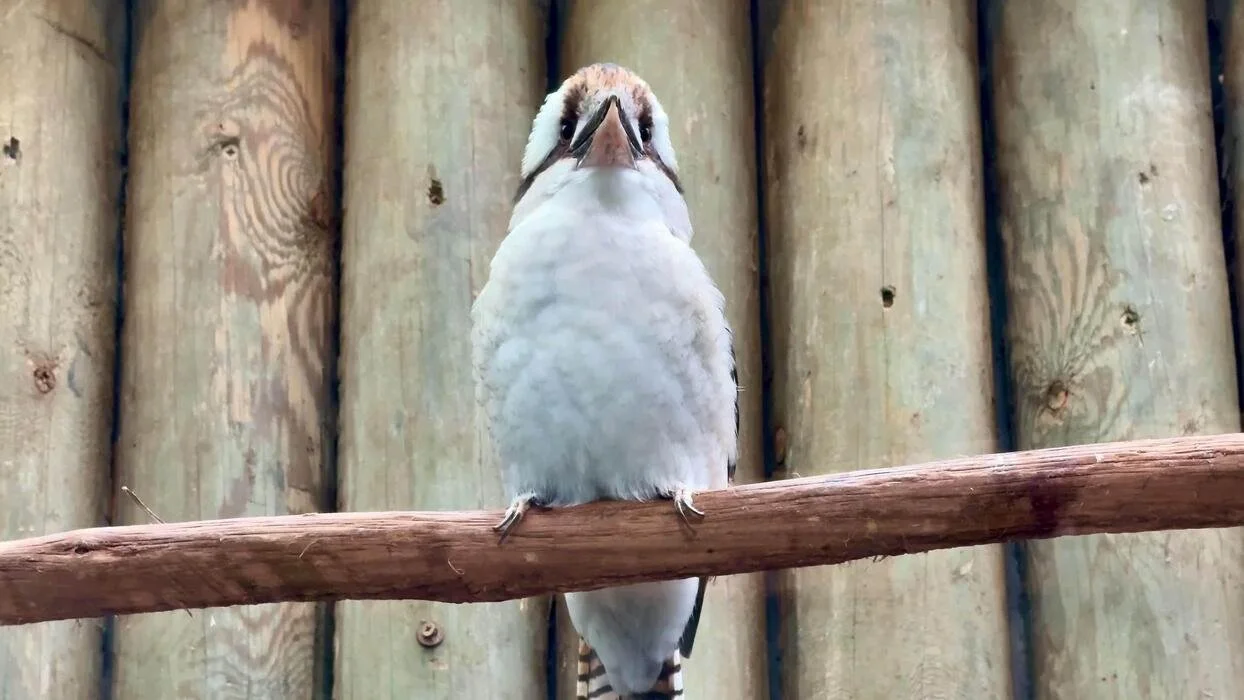
A healthy young fellow
Getting started
CG
From that point onward, I was writing this book. I did a lot of research for it because I can’t write a word until I’ve researched kookaburras to the nth degree. I heard an urban ecologist on Radio National called Darryl Jones, who offered to help me. Now we’ve become friends. I would reach out to him and talk about kookaburras. We had Zoom chats about everything to do with their behaviours and habitats, how monstrous they can be close-up, because they’re predators, they’re not cute
WV
What else did you do to support the writing?
CG
I connected with a local writer here, Gregory Day. I adore his work, and we had a loose connection through something else that he was working on. We devised a mentorship arrangement. So, for the next two and a half years, I wrote the book with a mentor. I liked the structure of being accountable to someone, having someone rigorously interrogate the work and having to defend it or reconsider. That was really provocative
And I had become a Writers Victoria member when I first moved to Victoria. Not knowing anyone, I wanted to be a paying member to connect with the writing scene over here. I did three workshops when I started writing The Kookaburra that were so valuable. I enrolled in one with Mirandi Riwoe about writing novella, because I thought it would be a novella. It ended up being developed into a novel, but a lot of what she covered in that workshop was so relevant and helpful
I did other workshops that were presented in partnership at the Melbourne Writers Festival. The one that lived with me is one of my favourite Irish writers, Caoilinn Hughes, who wrote The Alternatives. That was on writing themes. And then I did one with Laurel Cohen on manuscript development and then, of course, the Mirandi Riwoe one as well
Another funny connection came about when I read this beautiful essay in an edition of the Writers Victoria magazine. It was about parenting during those horrible bush fires. The writer was Siobhan Kavanagh and the bio said she lived in Geelong. I still think it was stalking, but I found her email address and reached out to her. I just wanted to say how much I loved her essay. Anyway, she became one of my closest friends. She was a beta reader for The Kookaburra, and she read an early draft when I completed the whole thing to give me a fresh impression. Particularly, I needed her feedback on the ending
Writers Victoria has offered me expert training, access to authors I would never otherwise have had, connection and community. Siobhan's a great example of that. I only met her because of reading the Writers Victoria magazine.
The process
WV
So, the manuscript took you two and a half years. How often were you writing?
CG
I was trying to be disciplined: writing every day before work for an hour and then writing on my days off and taking time off from the store where possible. It was an intense period
I tried to have contact with it every day. I had to live inside it, otherwise I’d lose touch with it, which means I was (admittedly) writing at work, in between customers. I used Google Drive, so I could sync it between my laptop and my phone. A lot of dialogue, things I’d overheard or observed, I’d note down on my phone in the back room of the shop. Then that would be part of the working document, and I’d rewrite it on a laptop later
Something interesting I know other writers do is what they call a ‘messy’ first draft. They put the story down roughly on paper so they’ve got the whole thing, like a mud map. Then they start from the start. I can’t work like that. The way I work is—it’s frustrating because it’s so much slower—I’ll go almost paragraph by paragraph. I have to perfect the sentence, the paragraph, before I can move on. It’s labour intensive. I think, ‘just get the story down’, but I can’t seem to do it. So, it’s sentence by sentence, paragraph by paragraph, and then a chapter, and then revise the chapter. Once it’s in its fourth or fifth draft—right, next chapter.
I found the story I made came out of the expression of it. If I haven’t gotten a sentence right, or the voice of the character right in the way that it plays out on the page, I don’t know what they’re going to do next. The sentence must be right in order for me to feel where the story might go. It sort of emerges out of the language itself. It’s something I didn’t really know about my own process until writing this. The rewriting and redrafting is integral to the process. It doesn’t just come out the way it appears on the page. It has to be reworked
I feel bad as I’ve said this in so many interviews and I can't remember who originally said it, but I will credit that it was not me … I was listening to an interview with a writer who was describing her process, and she said she had a working document plus another document she called ‘the Morgue’. When she deleted a paragraph, she put it into the Morgue in case she wanted to resurrect it and put it back into the working document
I thought it was such a brilliant idea, I did it for The Kookaburra. The interesting thing was I never once took something back out of the Morgue. Once it was in there, it was effectively deleted. I had the comfort of knowing that I could revisit it, but I never did
The Morgue document was about 85,000 words in the end—longer than the finished novel—from all the rewriting and redrafting and deleting and finessing. That whole document of the bits I cut was about 20,000 words longer than the actual novel
I must mention, I did a fantastic Varuna Residential Fellowship as well. They were a huge part of it. I had felt paralysed initially by the idea that you’re here at this place for two weeks to achieve this thing. There was a purpose to the trip
But I met some beautiful other writers in residence at the same time in those two weeks in the Blue Mountains. And just to have time and space in an idyllic setting and away from the grind of daily life to finish the book … That’s where I wrote and rewrote the ending and polished the manuscript off. It was a really important time
Getting published
WV
Did you feel all along that you were creating something that could get published?
CG
No, because I felt like … you just don’t know. There’s so much involved in the publishing industry that is completely out of your hands. The zeitgeist, certainly. Also, what books publishers are looking for at any one time, which can change quickly. Decisions can be driven by individual taste, and there’s nothing you can know about that
So no, not really. I’m not going to say that I didn’t think that it would be great if the manuscript led on to being published because that was what I was working towards. But the only thing I could control was my own work ethic. And I had no expectations that it would lead anywhere because otherwise I’d be heartbroken. So, I just trained myself not to expect anything, which doesn’t mean that you don’t try very hard for the outcome you want … Obviously, I entered it in the Victorian Premiers Literary Awards. So, you do that sort of thing because you ‘hope’, but you don’t do it because you ‘expect’
WV
But once you were awarded the prize for Best Unpublished Manuscript, did anybody from publishing contact you?
CG
Yes. I was lucky enough to sign with an agent before the Victorian Premier’s Literary Awards were announced. She’s Bec Slater at a4 Literary. She has been amazing, very good at her job, an incredible guide through this process
She went out on submission the day after the award ceremony. We went through that whole process for the next three to four weeks. A deal came through that we were really happy with. And there was a back-and-forth scenario with a few different places, which was exciting
Since signing with the Australian publisher, Allen & Unwin, it’s been picked up in a few other countries as well, which has left me totally floored. This kookaburra is going to be rather well travelled, it seems!
So far, I’ve had some incredible meetings and conversations with people whose names I’ve known for years. Just to meet them on terms of mutual respect and being able to pick their brains about their side of the industry has been fun because I’ve spent so long at the tail end of the supply chain. It’s been a real privilege to get that glimpse behind the curtain. All the conversations have been about building relationships long-term. It’s been amazing—you never think this is how it’s going to go
It all stems from the Prize as well. I didn’t realise how powerful it is. I did on some level, but once you’re in it, it’s a whole different kettle of fish. It’s such a magnet for the right people’s eyes
WV
It does bring both parties together. It lets the publishing industry know who is worth taking seriously.
And to see that all the steps you followed like doing writing courses, working with mentors, writing every day and entering competitions can produce these outcomes—it shows there is a pathway to publishing for talented emerging writers
CG
There is, but thanks to the support of lots of organisations and people. Sometimes we subscribe to this myth of the author as a lone figure, but there’s a whole ecosystem of opportunities and first-readers and mentors, and your community of other fellow writers who may be in a writer’s circle, and all the workshops they’ve done. There’s a huge network of people behind this manuscript, even though it has my name on it
If I hadn’t been to Varuna, if I hadn’t done those workshops at Writers Victoria, if I hadn’t had that mentorship arrangement with David McCooey first and then Gregory Day second, then it wouldn’t exist. I wouldn’t have been able to write it. I know some authors can work in complete isolation. I have friends who do, but for me personally, this manuscript resulted from the efforts of a lot of other people, not just me. That’s something I think about a lot